
Press Release
By Arthur Rieb
Business Development Manager e-Powertrain, Envalior
Metal and PBT are ideal partners in overmolded metal conductors, such as those found in the powertrains of electric vehicles. However, for engineers frequent and abrupt temperature changes put this “material marriage” to the test. Stress cracks can form, leading to defects in entire assemblies. PBTs with high elongation at break, hydrolysis resistance, and heat resistance from our Pocan® XHR range enable you to minimize this risk. This is demonstrated by the mounting frame for a clutch transmission.
Engineers often opt for PBT (polybutylene terephthalate) in many high-performance electrical applications because it exhibits consistently high electrical insulation properties that are independent of temperature. Metal components are often overmolded with PBT. If the resulting components, such as busbars, housings, or frames, are frequently exposed to abrupt temperature changes during use, the "marriage" between metal and plastic is running into trouble. This is because the very different thermal expansion rates of the two materials increase the risk of stress cracks in areas where they are in close contact. And these cracks can trigger defects in entire assemblies, which would necessitate costly repairs, for example, in electric vehicles. As you are aware, these issues can compromise long-term reliability and drive up lifetime system costs.
To help you solve such problems, our material experts have developed PBT grades that offer high elongation at break and can therefore adapt to thermal expansion without cracking or breaking. This capability helps you avoid premature component failures and improve durability in demanding thermal environments.
An example of such a material is Pocan® B3233XHR. The injection molding compound has a very high elongation at break of 3.6% and is the material of choice for the mounting frame of an inverter used in dual-clutch transmissions with integrated electric motors.
The integration of the mild hybrid electric motor into the dual-clutch transmission has the benefit that the electric drive supports all driving modes, whether starting off, reversing, or accelerating on the highway. This results in fuel savings of up to 15%. For OEMs and drivers, this translates into smoother performance and meaningful fuel savings up to 15%. The transmissions are installed in mild hybrid vehicles from various automobile manufacturers.
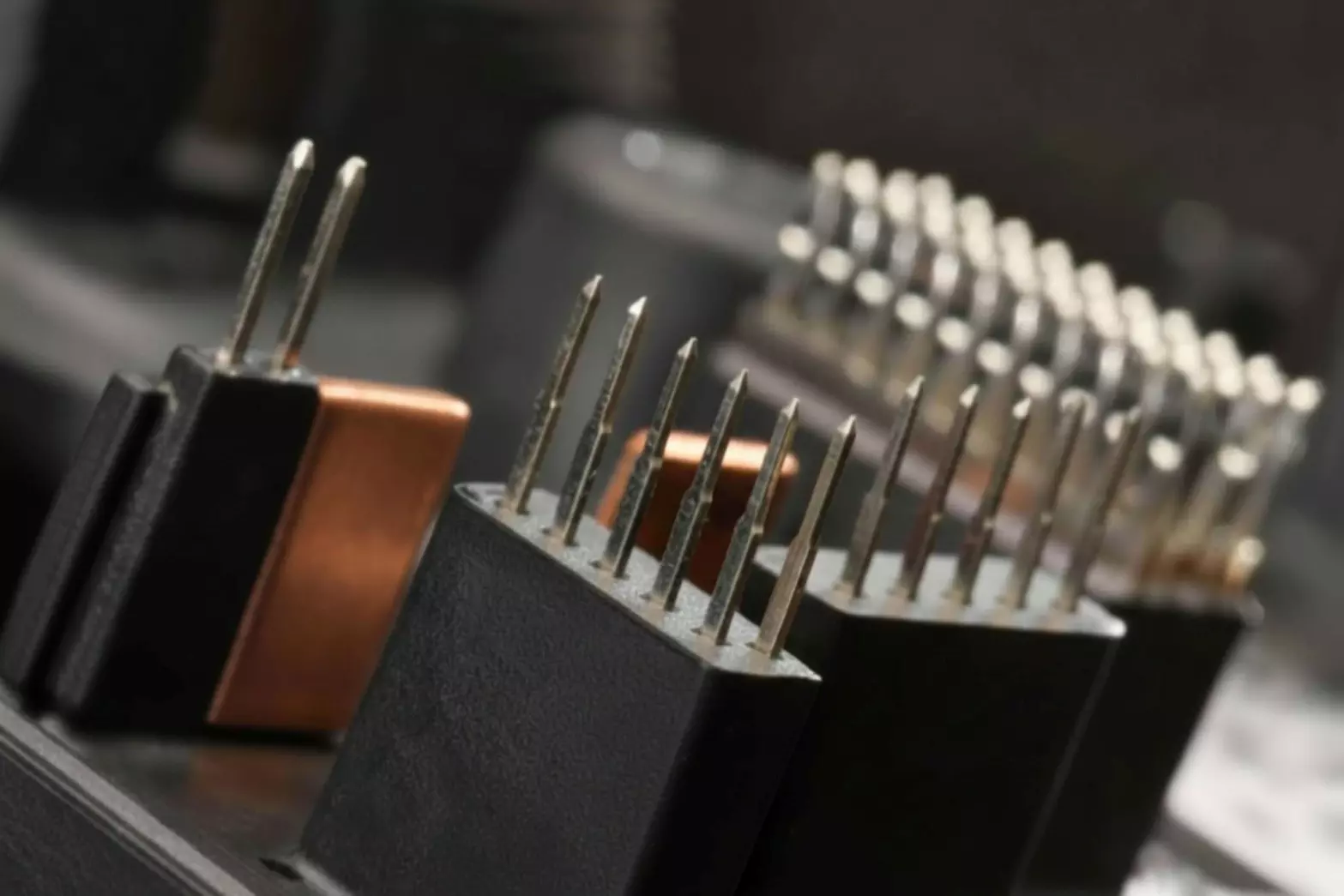
The mounting frame integrates, among other things, busbars that run across the entire component, pins for electrical contact, and screw domes for fastening the frame and the circuit board. The large number of these overmolded metal components and the high risk of stress cracks they cause necessitated the use of Pocan® B3233XHR as injection molding material.
The compound's outstanding elongation at break hardly diminishes even after many temperature cycles, because it is both highly resistant to hydrolysis and heat aging. Both of these factors prevent the plastic from becoming brittle, which ensures high functional reliability of the component and consistently good electrical properties. We have extensively tested this material behavior in thermal shock tests. For this purpose, component prototypes were subjected to numerous cycles of abrupt and severe temperature changes. The tests showed that the frame is able to withstand these extreme operating conditions. This gives you confidence that the material performs reliably under real-world conditions.
The excellent hydrolysis resistance of Pocan® B3233XHR (Xtreme Hydrolysis Resistant) in hot and humid environments has been confirmed in specimen tests based on the strict SAE/USCAR-2 Rev. 7 long-term tests of the US Society of Automotive Engineers (SAE). The compound achieved the highest classification, Class 5. We also investigated the thermoplastic's long-term resistance in hot air. Its impact strength remained almost unchanged after 3,000 hours of hot air storage at 150 °C.
The material’s good processing properties also provide advantages. It offers you roughly 30% better melt flowability than a standard PBT with the same glass fiber content, delivering performance on par with leading grades of the highly flowable Pocan® XtremeFlow product range. With its excellent flow characteristics, the compound can be processed at lower injection pressures. This keeps metal inserts securely in place, delivering precise and reliable results in series production.
Another advantage of our PBT engineering material reinforced with 30% glass fibers by weight is its high dimensional stability. This facilitates the production of dimensionally accurate components with tight tolerances and reduces thermal expansion at changing temperatures. Due to its low water absorption, the high level of electrical properties, such as the high dielectric strength and tracking resistance typical of PBT, is not subject to fluctuations. Plus, the compound has little tendency to cause electro corrosion when in contact with metal parts.
There is good application potential for Pocan® B3233XHR and other variants of the XHR product family in the powertrain of electric vehicles. We are considering, for example, a wide variety of housings for control units, connectors, busbars, and overmolded stators. The XHR product range includes unfilled compounds and compounds reinforced with up to 30% short glass fibers, flame-retardant material variants, and a product with high tracking resistance of 600 volts (CTI A). This broad portfolio allows you to select precisely the right grade for your performance, safety, and processing needs

Arthur Rieb is Business Development Manager for e-Powertrain at Envalior, based in Dormagen, Germany. Since joining the ADTS Europe team in December 2023, he is responsible for driving growth of Xytron™ PPS with a focus on e-powertrain applications across EMEA. He brings extensive experience in business and application development within the automotive and polymer industries. Arthur combines strong technical expertise with commercial insight to develop strategic partnerships, support customers, and advance innovation in the mobility sector.
Thermoplastic composites often meet performance expectations, yet inconsistent test results slow real world adoption. At Envalior, standardized testin...