
Tech Talk
Advances in laser welding
In this session you will be guided in selecting appropriate materials, designs, welding techniques, and optimal processing methods.
By Frank van der Burgt, PhD
Secondary technology expert at Envalior
In the automotive industry, laser welding is growing due to more vehicle electrification and consumer demand for safe and comfortable vehicle features. Fast and clean, laser welding is used on parts like cameras, climate controls, and even EV transmissions. It’s crucial to use the right material for laser welding. Some materials can increase defective parts, putting your brand’s reputation at risk. Instead, make sure to choose the right material solution to reduce your risk of defects.
The automotive industry is shifting demand away from traditional welding methods to laser welding, driven by increased vehicle electrification and growing consumer demand for comfort, safety, and performance-enhancing features. Globally, demand for laser welding is expected to reach 5.387 million USD by 2032as more electronic functions such as cameras, adaptive cruise control, and climate control are incorporated into automotive components.
For automakers, laser welding offers fast and clean processing as well as increased design flexibility, making it ideal for integrating sensitive components like advanced driver-assistance systems (ADAS), global navigation satellite systems (GNSS), and cameras. It provides moisture and dust protection for electronics and battery systems in electric vehicles. With the accuracy of laser beams, it’s also an efficient and relatively cost-effective technique for high-volume applications that require automation.
Although laser welding is being utilized more and more, you need to make sure you are using the best materials solutions. If you use the wrong materials, you may risk your brand’s and business’s reputation.
Certain market-leading laser welding materials have limitations and, in some cases, could lead to faults. Thus, faulty parts may lead to recalls, reputational damage, repair costs, and even liability for damage incurred. To get the process right, you need a partner with deep design expertise and material know-how.
Envalior, formerly Envalior and Lanxess HPM, can help. We offer a variety of materials for laser welding, including our high-performance Arnite® polybutylene terephthalate (PBT), which achieves faster cycle times than conventional solutions. Arnite PBT can be used in a range of welding material thicknesses and colorations – including our custom laser-transparent black – to accommodate a variety of application requirements and designs.
In a study where laser welding was performed on radar housings using our Arnite PBT material and a conventional PBT, Arnite PBT enabled welding cycles that are twice as fast, or faster, as competitive materials, with no signs of surface defects or burns. By choosing Arnite PBT (LT TV4 261) over conventional PBT, you can increase productivity and reduce your costs.
Looking at materials targeting demanding laser welding applications, our material’s moisture absorption is significantly lower than competitive materials. This equates to bettGreater stability and a lower risk of air leakage, allowing you to design parts with tighter tolerances and accommodate a range of laser welding options for rapid welding with excellent performance.
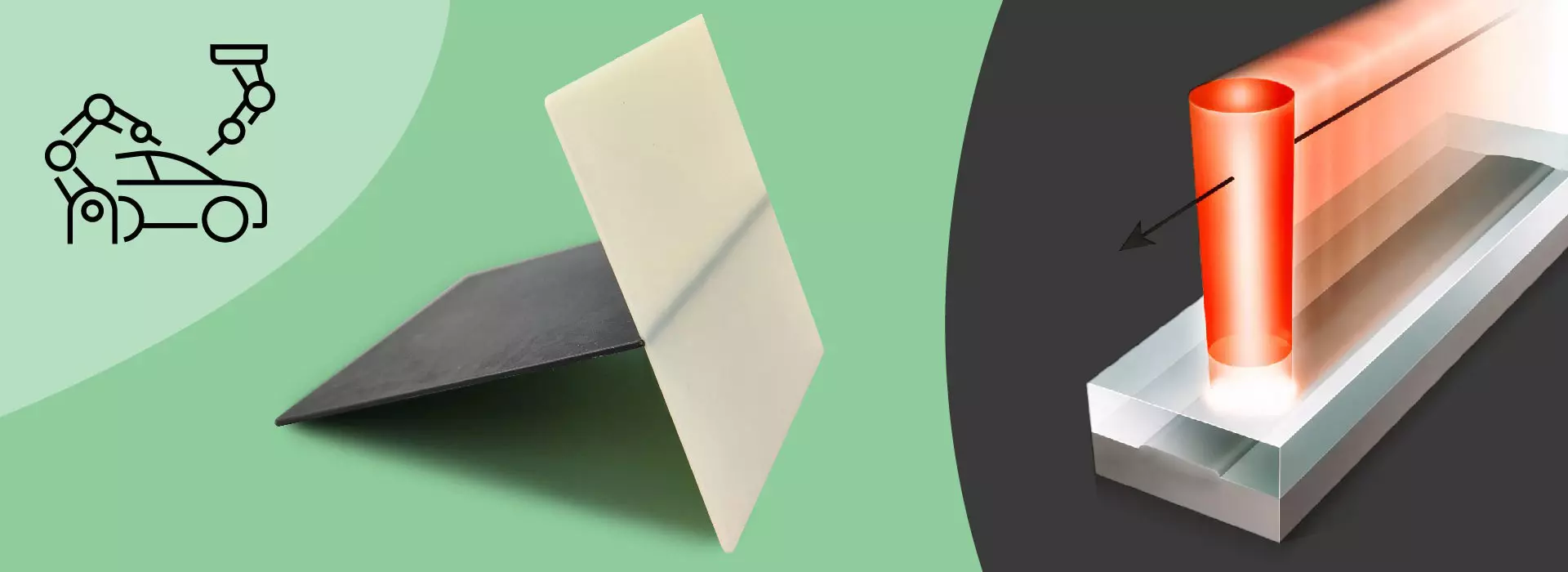
High transparency is essential for achieving thicker, more robust designs with improved dimensional stability, as it enables a wider processing window for laser welding. For instance, in transmission laser welding, the laser beam passes through a transparent or semi-transparent top layer to reach the underlying laser-absorbing component. The right balance of transparency and absorbance creates a melt pool precisely where the layers meet. As the lower part absorbs the laser energy and melts, it transfers heat to the top layer, causing it to melt too. When the molten polymers cool under pressure, they fuse together to form a weld seam.
A wider processing window means the part is less likely to develop defects during manufacturing. Compared to standard PBTs, Arnite (LT TV4 261) offers 300% better transparency, boosting manufacturing efficiency and reducing defects.
Standard PBTs are usually reinforced with glass fibers (GF) to maintain stiffness during welding, but additives often decrease the material's transparency. When a polymer's transparency is too low, welding becomes difficult or impossible. Instead of passing through the top layer, the laser may be absorbed by the plastic and cause damage to its surface before welding even starts. A naturally high trAs a high-transparency material, Arnite PBT provides an excellent foundation for laser transmission welding in a variety of thicknesses and GF percentages.
As a trusted partner to the automotive sector, our global team of engineers, scientists and technicians will work with you throughout the part design, creation, and optimization process to ensure a safe and reliable product.
We offer recommendations for the specific grades and welding techniques best suited to your application to ensure the strongest possible weld line. Additionally, we can be an alternative second source supplier to further reduce your supply chain risks, while working with you from start to finish to achieve competitive results.
Envalior, formerly Envalior and Lanxess HPM, is a global leader in material science innovation, with a robust portfolio of materials built to support next-generation technologies across a broad range of global industries, including automotive and electronics. Our solutions are backed by extensive research, testing and collaboration with OEMs and connector manufacturers, to deliver on all your safety, reliability and design flexibility needs.

Frank is part of the advanced engineering group within Envalior, Research & Technology. He joined Envalior in 2006 and held positions in polymer characterization and research and development. Frank received his PhD in 2002 on the topic of polymer crystallization in the Chemical Technology department of the Eindhoven University of Technology.
In this session you will be guided in selecting appropriate materials, designs, welding techniques, and optimal processing methods.

The $125 billion athletic footwear industry faces growing pressure to reduce its environmental impact. Governments, consumers, and leaders demand sust...
Concerns over plastic kitchen utensils have risen due to health risks from substances like PAA and BPA, now restricted by the FDA and EU. Manufacturer...